
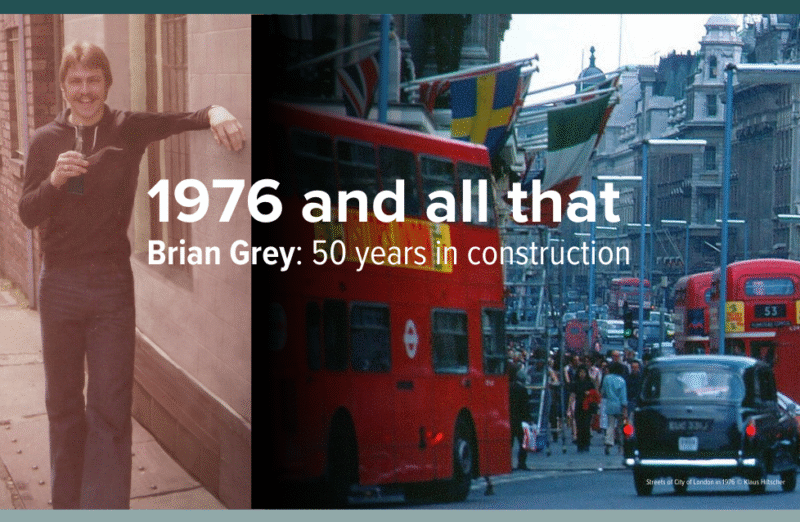
Brian Grey: 50 years in construction
In 1976, Brian Grey started his first job as a trainee Quantity Surveyor. This year, 2026, he will mark 50 years working in the construction industry. Over five decades, the profession – and the wider industry around it – has changed almost beyond recognition. In this personal reflection, Brian looks back at how projects were delivered, how people worked together, and what day-to-day life in construction looked like, long before email, mobile phones and digital tools became the norm.
What follows is Brian’s own account, in his own words.
Starting out in 1976
I started my first job as a trainee QS in 1976, so 2026 will mark my 50th year in the construction industry. Not surprisingly, the QS profession and wider construction industry are very different today. So, what has changed? Almost everything, really.
Life before digital communication
The most significant change has been in communications. Back then, there was no internet, no mobile phones, and AI referred to artificial insemination. Computers were the size of a bus and most communication was by post.
Most days, our postman was kept busy delivering dozens of drawings that often still smelled awful from the ammonia used by the dye line printers that consultants used. We waited expectantly, scale rules and dim paper at the ready.
All letters had to be signed by either a Partner or an Associate, and I didn’t even have a telephone on my desk. Probably because I didn’t need one.

Calculators, Comps and getting the numbers right
Only Partners were allowed to use calculators, and all our dims were extended by the fearful ‘Comps’. Comptometer operators were, for the most part, formidable and highly experienced women who used a comptometer machine for extending taking-off dims, final accounts and other key calculations.
Comptometer machines were mechanical calculating machines that looked a bit like the old tills you used to see in shops. For some calculations, they had to press so many buttons simultaneously that they needed to use all ten fingers to complete them. Nothing left the office without being checked by Comps.
The architect at the centre of everything
The Architect was the focal point of the project team. He (it was invariably a ‘he’) would be the first professional to be appointed and was very influential in the selection of the other members of the design team.
The Architect usually also acted as project manager (a term which didn’t exist then) and planning consultant. I recall my old boss, the senior partner in our firm, addressing the Architect as ‘Mr. Williams’. How the mighty are fallen!
How projects were delivered
Almost all projects were what we now call traditional contracts with BQs measured in much more detail than is the case now. The design team prepared all the details up to RIBA Stage 4, although some contractors produced production drawings for approval, CDPs were very much the exception.
On a large job, the QS might be given three months to prepare the BQ.
This sort of thing was made possible by the professional institutions, which mandated a fixed scale of fees that all chartered professionals adhered to. They reflected the real cost of providing a full professional service, so there was no cost cutting to win a project as we all charged the same fee. The intention was to get firms to compete on service quality alone, but Margaret Thatcher put a stop to that as she regarded it as a cosy cartel.
Early projects and learning the trade
The first project which I worked on was a final account for a car factory for British Leyland. It was an old project, so the Bills had imperial dimensions, the take-off being in feet and inches.
The Bill units for excavations and concrete, for example, were cubic yards, and since there are 27 cubic feet in a cubic yard, I had to learn my 27 times table when measuring variations. The metric system makes life so much simpler.
We worked on lots of car factories at my first firm, and they usually had “Big 6” asbestos cement roofs. Back then, asbestos was still considered a wonder product and was widely used in construction, thus ensuring lucrative remediation projects in the future.
Housing, government and the shape of the industry
We were living under a Labour government, so council housing was still a major driver in the industry. In London, this involved either taking redundant industrial land and developing it with new-build housing or converting run-down Victorian slum housing into flats.
A key client for us was Islington Council, and those flats are now mostly sold off and converted back to grand family homes for human rights lawyers.
Health, safety and site life
Health & safety had not been invented. This period was decades before CDM, so safety (health came much later) was left entirely up to the Contractor.
PPE was rarely worn and then only by tradesmen, so construction sites were much more dangerous than they are now.
Changing social attitudes
Social attitudes were also very different in the seventies. Comments that would rightly be unacceptable today were commonplace and rarely challenged, and I was invariably the only person who didn’t smoke in meetings.
On the other hand, the industry was much more convivial. Friday lunchtime pub sessions were the norm, and it was almost mandatory for the Contractor to take the QS for lunch after every interim valuation.
Looking back from today
So, a very different industry from the one we now work in. The 70s and 80s were great days to learn your trade, but times have changed, mostly for the better.
We are a much more efficient industry (I exclude the planning system, which has become immeasurably worse), but the biggest loss is manifest in the downside of electronic communications which prioritise speed over time for reflection.
Never again can we buy time by saying, “the report is in the post”.
____________________________________________________________________________________________________
Disclaimer: This article reflects Brian Grey’s personal memories and opinions formed over a long career in the construction industry. It is not intended to represent the views, policies or positions of Leslie Clark as a business.
If you’re interested in how Leslie Clark can support your construction consultancy needs, don’t hesitate to get in touch – office@lclark.com